


Table of Contents
- Why Personal Care Alternatives Are Worth a Second Look
- Brand-Name vs. Generic Personal Care Products: What Actually Differs
- How to Compare Personal Care Product Ingredients
- Affordable Skincare Alternatives That Still Do the Job
- Personal Care Essentials for Students on a Tight Budget
- What to Skip and What to Buy Cheap
- Where to Buy Personal Care Alternatives in One Order
- Conclusion
- Frequently Asked Questions
Last Updated: October 18, 2026
Why Personal Care Alternatives Are Worth a Second Look
Walk down any drugstore aisle and you'll notice the pattern: the same cleanser, moisturizer, and shampoo formulas sit on shelves at wildly different prices, and the gap rarely reflects what's inside the bottle, which is why alternatives to expensive brand name personal care products are worth a second look. At Nehemiah Country Store, we hear from shoppers every week who want to cut their personal care spending without settling for products that leave their skin tight, their hair flat, or their pets itchy. That's a fair goal, and it's easier to reach than most people expect.
The short version: you can replace most of your routine with well-chosen alternatives to expensive brand name personal care products and keep the results you actually care about. The catch is knowing which categories reward a cheaper pick and which ones you should not touch.
Below, we'll break down where the money goes, how to read an ingredient list in under a minute, and which swaps are safe to make first.
Brand-Name vs. Generic Personal Care Products: What Actually Differs
The real difference between a brand-name product and a generic one usually comes down to three things: formulation polish, marketing spend, and packaging. The active ingredients that do the work, like cleansers, moisturizers, and sun filters, are often the same or close cousins.
Where the Price Gap Comes From
Most of the premium you pay covers advertising, celebrity placement, and shelf space, not the formula itself. A fragrance that costs more to develop, a heavier glass bottle, and a national TV campaign all show up in the sticker price. None of those change how well a product cleans or moisturizes.
When the Brand Is Worth It
Some categories do earn their price. Prescription-strength treatments, sunscreen with a verified SPF rating, and anything for a diagnosed skin condition belong in the hands of a dermatologist and a regulated product. For daily basics, though, a store-brand or smaller-brand version often performs the same job.
How to Compare Personal Care Product Ingredients
Comparing personal care product ingredients is the fastest way to tell whether a cheaper product is a real substitute or a downgrade. Flip the bottle, find the first five ingredients, and match them against the pricier version. Those first five make up the bulk of the formula.
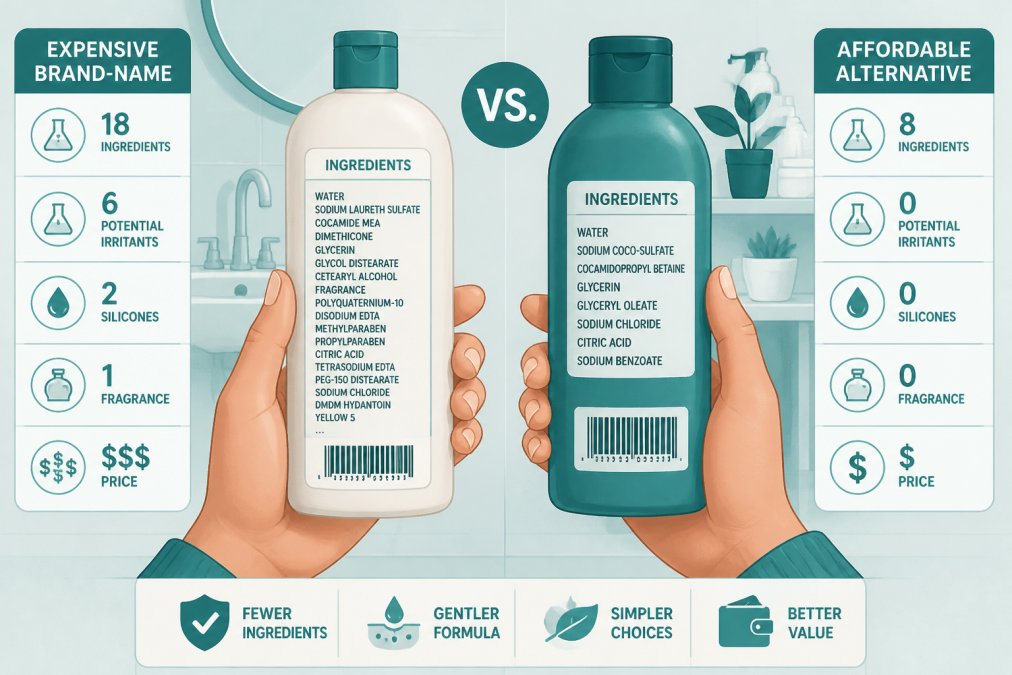
A simple checklist we use:
- Do the first five ingredients match or closely overlap?
- Is the active ingredient (cleanser, moisturizer, sun filter) listed at a comparable position?
- Are there fragrances or dyes you know your skin reacts to?
- Does the cheaper version skip a preservative that keeps it stable?
- Is the pack size per ounce actually cheaper, not just the sticker price?
Affordable Skincare Alternatives That Still Do the Job
Affordable skincare alternatives work best when you match the product to the job instead of the label. A gentle cleanser, a basic moisturizer, and a broad-spectrum sunscreen cover most daily needs, and none of them require a luxury price tag.
Cleansers, Moisturizers, and Sunscreen
For cleansers, look for a mild surfactant blend and skip anything that leaves your face tight after rinsing. For moisturizers, glycerin and ceramides do the heavy lifting, and a simple formula often beats a ten-ingredient one. For sunscreen, buy the SPF rating you'll actually reapply, and check that it's broad-spectrum.
What most guides miss: the cheapest upgrade to your routine isn't a new product, it's using less of the one you have. A pea-sized amount of cleanser and a nickel-sized amount of moisturizer are usually enough.
Personal Care Essentials for Students on a Tight Budget
Students building a first personal care kit should buy the boring basics in bulk and skip the trend items until the budget allows. A gentle cleanser, a moisturizer, a sunscreen, a deodorant, and a toothpaste cover the essentials, and buying larger sizes of the ones you use daily cuts the cost per use.
Pet owners in shared housing should also budget for their animals. A bar soap like the BeNat Pets All-Natural Furry Pet Soap Bar at $6.09 lasts a long time if you keep it dry between baths, and it's enriched with lavender, coconut, citronella, and eucalyptus oil.
BeNat Pets. All-Natural Furry Pet Soap Bar. 5.8 oz. →

What to Skip and What to Buy Cheap
Skip the products where the brand premium buys you nothing: body wash, basic shampoo, cotton rounds, and everyday lotion. Buy cheap on anything you use daily and replace often, because the savings compound.
Spend more on sunscreen, anything for a diagnosed skin condition, and products you apply to broken or irritated skin. Those are the spots where a bad formula causes real problems.
| Category | Buy Cheap? | Why |
|---|---|---|
| Body wash | Yes | Cleansing agents are similar across price points |
| Basic shampoo | Yes | Same surfactants, different fragrance |
| Sunscreen | No | Verify broad-spectrum SPF rating |
| Diagnosed skin conditions | No | Needs a regulated, targeted formula |
| Pet shampoo bars | Yes | Natural bars at $6-$8 do the daily job |
Where to Buy Personal Care Alternatives in One Order
The biggest hidden cost of shopping cheap is time. Driving to three stores to save a few dollars per item usually costs more in gas and hours than it saves. That's the case for buying your alternatives in one order from a store that stocks many categories.
At Nehemiah Country Store, we built our catalog around exactly that problem. You can add personal care, household basics, and pet supplies to a single cart and get fast shipping to your door, without juggling multiple checkouts. Our trending deals rotate regularly, so the everyday items you reorder most often stay affordable.
For pet owners, our grooming lineup covers the daily basics in one place: the BeNat Oat Shampoo Bar at $8.12, a Dog Paw & Claw Care Cream at $3.42, and a Pet Grooming Comb at $6.42. That's a full grooming kit for under $20.


Conclusion
Cutting personal care costs isn't about settling for less; it's about spending where the formula actually matters and saving everywhere else. Start with the ingredient checklist, swap your daily basics first, and keep the premium spend for sunscreen and anything a doctor recommends.
When you're ready to restock in one go, Nehemiah Country Store makes it simple: a wide catalog across personal care, household, and pet supplies, fast shipping, and trending deals that keep your everyday essentials affordable. Shop now and build a routine that costs less without feeling like a compromise.
Frequently Asked Questions
Are generic personal care products as good as brand-name products?
Often, yes. Generic and store-brand personal care items must meet the same basic safety and labeling rules as brand names, and many are made in the same facilities. The real differences usually come down to fragrance, texture, and packaging rather than how well the product cleans or moisturizes. Check the ingredient list and look for the active ingredients you need, then compare the price per ounce. If a generic version lists the same key ingredients in a similar order, it is usually a safe swap.
How can I compare ingredients in personal care products?
Start with the first five ingredients, since they make up most of the formula. Look for the same cleansers, moisturizers, and active ingredients you see in the brand-name version. Ignore marketing claims on the front and read the back label. If you have sensitive skin, patch test any new product on your inner arm for a day before using it on your face. Comparing price per ounce alongside the ingredient list gives you the clearest picture of value.
Which personal care products are worth buying on a budget?
Cleansers, body lotion, lip balm, cotton rounds, and sunscreen are usually safe to buy at a lower price because the formulas are simple and the ingredients are easy to compare. Basics like petroleum jelly and fragrance-free moisturizers work well at any price point. Spend more only on products where the formula is hard to copy, such as prescription treatments or products for a specific skin condition.
What personal care products should you avoid buying cheaply?
Be careful with anything that goes near your eyes, products for broken or irritated skin, and sunscreen that does not list broad-spectrum protection. Also avoid unlabeled or expired products, and skip cheap razors that leave nicks. For these items, check the label for active ingredients and expiration dates rather than assuming a low price means low quality. When in doubt, choose a mid-priced option with a clear ingredient list.
How can I save money on everyday personal care items?
Buy the largest size you will realistically use, choose fragrance-free basics, and compare price per ounce instead of the sticker price. Stick to a short routine of cleanser, moisturizer, and sunscreen instead of buying many single-purpose products. Buying several essentials in one order also saves on shipping and time. Personal care alternatives do not have to mean lower quality; they usually mean fewer extras and simpler packaging.


