


Table of Contents
- Is Buying Trending Products Online Worth It? The Honest Verdict
- How to Tell If a Viral Product Is Worth It Before You Buy
- How to Check Online Product Reviews Without Getting Fooled
- How to Avoid Scams When Shopping Online
- Online Shopping Return Policy Checklist: What to Verify Before Checkout
- Real Cost of Trending Products: Price, Shipping, and Long-Term Value
- When to Buy Trending Products and When to Wait
- Conclusion: Making Smart Buying Decisions on Trending Products
- Frequently Asked Questions
Last Updated: October 14, 2026
Is Buying Trending Products Online Worth It? The Honest Verdict
Is buying trending products online worth it? For most shoppers, yes, if you check the return policy and reviews before you pay.
Trending products see a sharp, short-term jump in demand, usually driven by social media, viral videos, or seasonal timing.
Here is what most buying guides skip: a product can be genuinely popular and still be wrong for you.
How to Tell If a Viral Product Is Worth It Before You Buy
A viral product is worth buying when it solves a problem you already have, costs less than your alternative, and comes with a return policy you can actually use. If any of those fail, wait.
Most impulse buying happens because a video makes the product look effortless. Slow that moment down by ten minutes.
The 5-Question Test for Viral Products
Run every trending item through these five questions before you add it to your cart:
- Would I want this if I had never seen it online?
- Does it replace something I already own or plan to buy?
- Is the purchase price reasonable for how often I will use it?
- Can I return it if the product quality disappoints me?
- Are the customer reviews specific, or do they all sound the same?
Two or more "no" answers means you are reacting to hype, not need. Close the tab and revisit in a week; if you still want it, the product lifecycle has settled and stock is steadier.
How to Check Online Product Reviews Without Getting Fooled
Learning how to check online product reviews comes down to reading the middle ratings, not the extremes. Five-star and one-star reviews are the easiest to fake and the easiest to write in anger.
Search interest tells you how many people are curious; reviews tell you how many were satisfied. Those are different numbers, and the second matters more.
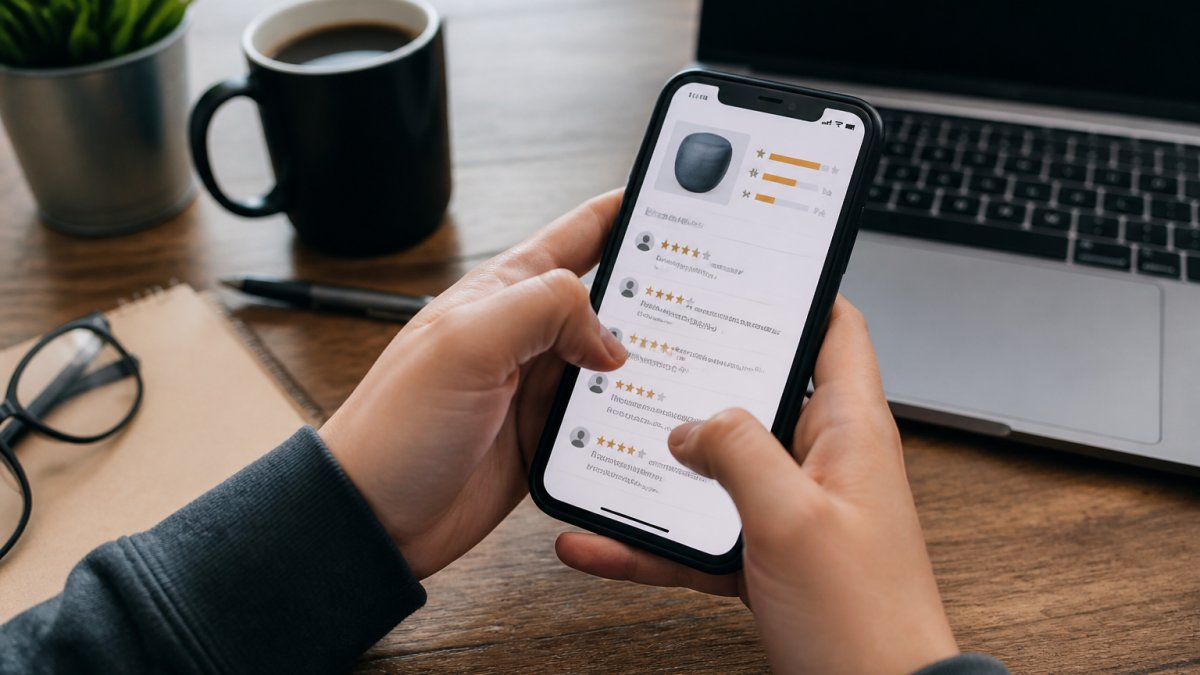
Red Flags in Customer Reviews
Watch for these patterns, which show up again and again on low-quality listings:
- Dozens of reviews posted within the same week, all with similar phrasing
- Praise that describes shipping speed but never the product itself
- No photos from real buyers, only manufacturer images
Genuine reviews mention specifics: the size that ran small, the battery that lasted two days, the color that looked different in person.
How to Avoid Scams When Shopping Online
Avoiding scams when shopping online starts with one rule: never pay a seller you cannot identify, contact, or trace to a real business address.
A common mistake is trusting a storefront because it looks polished.
Check these before entering card details:
- A physical business address listed on the site, not just an email form
- A phone number or chat option that reaches a person
- Secure checkout, shown by a padlock and an "https" address
The FTC's guidance on online shopping scams explains that scammers frequently push unusual payment methods precisely because those payments are hard to reverse.
If a deal depends on you acting in the next ten minutes, that urgency is the scam working as designed.
Online Shopping Return Policy Checklist: What to Verify Before Checkout
An online shopping return policy checklist takes two minutes and saves the cost of a mistake. Before you pay, confirm the return window, who pays return shipping, and whether the item must be unopened.
Here is the checklist we suggest keeping handy:
- Return window length, counted from delivery or from order date
- Who covers return shipping costs
- Condition rules: unopened, unused, original packaging
| What to Check | Why It Matters | Red Flag |
|---|---|---|
| Return window | Limits how long you have to decide | Under 14 days |
| Return shipping | Changes your real cost | Buyer pays both ways |
| Condition rules | Decides if opened items qualify | "Unopened only" |
| Exclusions | Some categories never qualify | No stated policy |
| Warranty | Covers defects after the window | None mentioned |
For electronics and pet supplies especially, a warranty matters more than a low price. A cheap item with no warranty is not value for money; it is a gamble.
Real Cost of Trending Products: Price, Shipping, and Long-Term Value
The real cost of a trending product is the purchase price plus shipping, accessories, consumables, maintenance, and early replacement, minus resale value. That total is where most viral buys lose their shine, and almost no listing shows it.
A $20 gadget that lasts three months costs more per year than a $60 version that lasts three years. Durability and reliability never appear in the ad.
PurrPlay Self-Rolling Cat Toy Ball →
The Total Cost of Ownership Formula
Add these five lines before you decide a trending item is a bargain:
- Purchase price, the sticker price, in USD.
- Shipping and tax, free shipping is not free; it is built into the price or paid at checkout.
- Consumables and accessories, batteries, filters, refill pads, proprietary chargers, replacement blades. A cheap device with expensive refills is a subscription in disguise.
- Maintenance and repair, cleaning supplies, replacement parts, or the labor to fix it.
- Replacement interval, how many months or years before you buy it again.
Then subtract resale or salvage value: what you could realistically get back on a resale marketplace, or whether the item can be recycled or returned for credit.
Worked Example: Two Pet Toys, Two Real Costs
Take two items from the table below. The $3.27 Smart Rolling Pet Ball runs on a battery; if a dog destroys it in six weeks and you replace it four times a year, your annual cost is roughly $13 plus batteries.

Neither number is automatically right. The cheaper ball wins if your pet plays gently and loses interest fast; the rechargeable ball wins if your pet is a heavy chewer and you would otherwise replace the cheap one repeatedly.
Where Trending Products Quietly Cost More
- Proprietary parts. A device that only accepts the maker's refills locks you into their pricing.
- Short warranty windows. A 30-day warranty on an item with a motor or battery tells you the seller expects it to fail after the return window.
- No resale market. If nobody wants a used one, your salvage value is zero.
Trending Pet Products That Hold Up: A Quick Comparison
Pet supplies are one of the strongest categories for repeat purchases, because pet owners buy the same items again and again. Here is how a few of our current best sellers compare.
| Product | Price | Best For | Key Detail |
|---|---|---|---|
| PurrPlay Self-Rolling Cat Toy Ball | $6.66 | Solo cat play | Plush-covered silicone, self-rolling |
| Smart Rolling Pet Ball | $3.27 | Budget shoppers | Sensor and motor, battery included |
| Interactive Smart Dog Toy Ball | $6.42 | Puppies and cats | USB powered, four colors |
| 360 Smart Automatic Rolling Pet Ball | $63.50 | Energetic dogs and cats | USB rechargeable, chew-resistant |
| Ultrasonic Anti-Bark Dog Training Collar | $24.84 | Bark training | Ultrasonic plus gentle vibration, USB rechargeable |
The $3.27 ball and the $63.50 ball both roll. The higher tier buys rechargeability, chew resistance, and quiet operation. If your dog destroys toys in a week, the cheaper ball is the expensive choice.


Pet owners who want one order to cover toys, training gear, and household basics without a second checkout.
When to Buy Trending Products and When to Wait
Buy trending products when the item replaces something you already use, the return policy is clear, and the price is stable. Wait when it is new to the market, sold out everywhere, or priced above similar products. The hard part is recognizing when hype is doing the deciding.
How Hype, Scarcity, and Social Proof Distort Value
Three forces push trending products past their real worth:
- Social proof. When thousands of people appear to love an item, your brain reads that as evidence of quality. It is evidence of visibility, not quality.
- Scarcity. "Only 3 left" and "sale ends in 10 minutes" are engineered to short-circuit comparison. Real scarcity raises prices because supply is genuinely short; manufactured scarcity raises prices because the seller knows you will not check.
- Influencer framing. A paid promotion shows the product at its best, in a controlled setting, with editing. It does not show the third week of use, the battery that stopped holding a charge, or the return that cost you shipping both ways.
The tell is urgency. If a deal depends on you acting in the next ten minutes, that urgency is the marketing working as designed, not a signal that the product is good.
A Buyer's Decision Framework
Score the trending item against the established alternative you would otherwise buy. One point per "yes."
| Question | Trending Item | Established Alternative |
|---|---|---|
| Does it solve a problem I already have? | ||
| Is the total cost of ownership lower over one year? | ||
| Are there independent reviews older than 90 days? | ||
| Is the return policy clear and usable? | ||
| Can I name the specific use case in my home? |
If the trending item does not beat the alternative on at least three lines, wait. Waiting is not losing the deal, it lets the trend settle so price and reviews catch up to reality.
Signals to Wait
- The product launched within the last few weeks and has no long-term reviews
- Prices are climbing because of scarcity, not because of added features
- Every listing uses the same stock photos from an unknown source
Signals to Buy
- The product has been on the market long enough for honest reviews to accumulate
- The price has settled after the initial spike
- You can name the specific problem it solves in your home
Market saturation is your friend. Once a dozen sellers carry the same item, competition pushes prices down and quality differences become visible. Buying at the peak means paying the hype premium.
Conclusion: Making Smart Buying Decisions on Trending Products
The honest answer is that buying trending products online is worth it when you treat the purchase like a decision, not a reaction.
That is the standard we hold ourselves to at Nehemiah Country Store. We stock trending items across pet supplies, household essentials, and personal care, ship orders quickly, and keep our trending deals priced for everyday budgets.
Get started with Nehemiah Country Store and turn your next trending find into a purchase you do not regret.
Frequently Asked Questions
How can you tell if a trending product is worth buying?
Check three things: real customer reviews across multiple sources, a clear return policy, and the total cost including shipping. Look for reviews that mention durability and long-term use, not just unboxing excitement. If a product has thousands of five-star reviews but no detailed criticism, be skeptical. A product worth buying will have a mix of honest feedback and a seller who stands behind it with easy returns.
Are viral products online usually good quality?
Not always. Some viral products are genuinely useful, while others rely on hype and social proof. Quality varies widely by seller. Before buying, check whether the product has a warranty, read reviews that mention how it holds up after weeks or months, and verify the return policy. For example, a pet toy like the PurrPlay Self-Rolling Cat Toy Ball at $6.66 is low-risk, but a $63.50 electronic pet ball deserves more scrutiny before you commit.
How do you avoid scams when buying trending products online?
Stick to retailers with clear contact information, secure checkout (look for HTTPS), and a documented return process. Avoid deals that seem too good to be true, especially on social media ads. Check for customer reviews on independent sites, not just the seller's page. If a store does not list a physical address or phone number, that is a red flag. Also, use a credit card for added fraud protection.
Should you buy a trending product or wait for reviews?
For low-cost items under $10, buying early is usually fine because the risk is minimal. For anything over $50, wait a few weeks until independent reviews appear. Early buyers often face first-generation bugs or poor quality control. Waiting also lets you see if the product stays popular after the initial hype fades. If it is still recommended a month later, it is more likely a solid purchase.
What should I check in an online store's return policy before buying?
Look for the return window (30 days is standard), who pays return shipping, whether you need original packaging, and if there are restocking fees. Also check if the policy covers defective items separately. A good return policy is easy to find on the product page, not buried in fine print. If you cannot find it in under a minute, that is a sign to shop elsewhere.


