


Table of Contents
- What Makes a Toy Essential for Young Children
- Developmental Toys for Toddlers: Building Skills Through Play
- Educational Toys for Preschoolers: Learning Through Play
- Top Essential Toys for Young Children from Nehemiah Country Store
- How to Organize a Playroom: Toy Rotation and Storage
- Sustainable and Budget-Friendly Toy Alternatives
- Choosing Toys for Neurodivergent Children
- Conclusion: Building a Playroom That Grows With Your Child
- Frequently Asked Questions
Last Updated: September 17, 2026
What Makes a Toy Essential for Young Children
An essential toy is one a child returns to repeatedly because it matches their developmental stage and can be used in more than one way. This guide from Nehemiah Country Store breaks down the essential toys for young children by age and skill, from plush companions for babies to building sets for school-age kids.
Safety Standards and Choking Hazards
Choking is the leading hazard for children under three, which is why small parts are banned from toys labeled for that age group. Under the Consumer Product Safety Commission small parts rule, toys intended for children under three must not contain parts that fit entirely inside a small-parts cylinder.
- The age label on the packaging, and whether it matches your child's actual chewing and mouthing habits
- Whether any part can detach under pulling or twisting
- Whether batteries are secured behind a screw-fastened compartment
Developmental Toys for Toddlers: Building Skills Through Play
The best developmental toys for toddlers target skills emerging between ages one and three: fine and gross motor skills, early language, and cause-and-effect. A toy that rewards an action with a sound, light, or movement teaches a toddler their choices matter.
Educational Toys for Preschoolers: Learning Through Play
Educational toys for preschoolers work best when they build cognitive development without feeling like a lesson. Between ages three and five, children develop logical thinking, spatial awareness, and social-emotional skills from taking turns and losing gracefully. The toys that carry the most weight are the ones a child can pick up at three and still find a new use for at five.
- Construction and building sets. Blocks, magnetic tiles, and interlocking bricks develop spatial awareness and planning because the child pictures a structure before assembling it. A three-year-old stacks; a five-year-old builds a bridge and tests whether it holds.
- Manipulatives. Lacing beads, peg boards, pattern blocks, and threading sets build fine motor control and early math concepts like sorting, sequencing, and one-to-one correspondence, quietly preparing a hand for handwriting.
- Simple strategy and turn-taking games. Memory match, cooperative board games, and card games built for ages three and up teach rule-following, waiting, and handling a loss. Choose games with two to four rules, not ten.
- Pretend play props. A pretend kitchen, play food, dress-up items, and doll play let a child practice sequencing (first we cook, then we eat), vocabulary, and empathy by acting out what another person feels.
- Puzzles. Frame puzzles with knobs for threes, 12- to 24-piece jigsaw puzzles for fours and fives. Puzzles build visual-spatial reasoning and persistence, and the difficulty is easy to scale up as the child masters each size.
Top Essential Toys for Young Children from Nehemiah Country Store
These five picks cover the range from newborn soothing to school-age building, and each earns its place through repeated use rather than novelty.
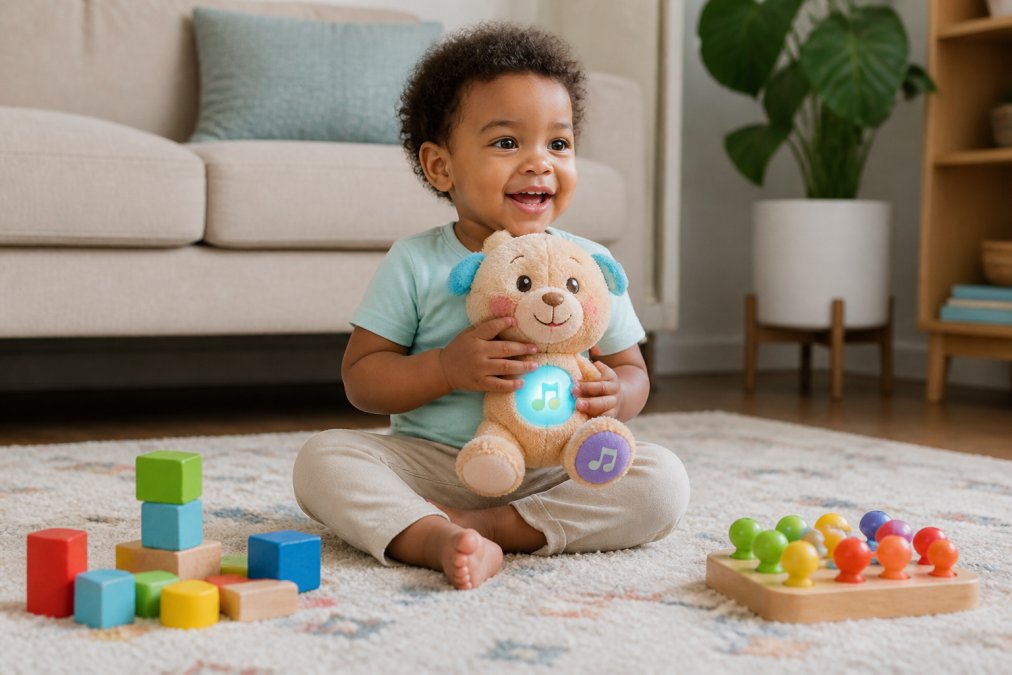
Baby Soothing Plush Music Toy
A soft plush lamb with calming music and gentle breathing motions, built for bedtime and naps. The compact size packs easily for travel, and the materials are listed as safe and durable for babies and toddlers. At $11.91, it is the lowest-cost way to add a consistent sleep cue to your routine.
Sound Machine Soothe 'n Snuggle Otter Portable Plush Baby Toy
This otter pairs a musical sound machine with a rhythmic breathing motion that mimics a sleeping chest. It offers 11 sensory discoveries across sight, hearing, and touch, with up to 30 minutes of customizable music and sounds, volume control, and soft lights. The fabrics are extra-soft and machine washable once the electronics are removed. It costs $17.22.
Kids Sensory Toy
An interactive sensory trainer for ages three to 14, designed around hand-eye coordination, reaction time, and cognitive development. It also targets emotional intelligence, visual perception, and sensory skills, and works as a parent-child activity rather than a solo screen. The kit includes two hooks, a rope, six grab sticks, a main pole, and a USB charging cable. Available in yellow or blue at $10.83.

Educational Tic-Tac-Toe Toy
A durable PVC take on tic-tac-toe that pushes critical thinking and turn-taking instead of passive entertainment. It develops hand-eye coordination and interactive skills while encouraging parent-child communication, and suits a wide age range with a focus on ages seven to 14. It sells for $36.63 in British Orange or British Yellow.
Kaaba Building Blocks Educational Toy
A small-particle building block set in white, aimed at ages seven to 14. Construction sets like this develop spatial awareness and problem-solving because the child plans a structure before assembling it. The set ships as one package at $26.85.
| Toy | Price | Ages | Primary Skill Built |
|---|---|---|---|
| Baby Soothing Plush Music Toy | $11.91 | Babies and toddlers | Calming, sleep routine |
| Soothe 'n Snuggle Otter | $17.22 | From birth | Sensory exploration |
| Kids Sensory Toy | $10.83 | 3-14 years | Hand-eye coordination |
| Educational Tic-Tac-Toe Toy | $36.63 | 7-14 years | Critical thinking |
| Kaaba Building Blocks | $26.85 | 7-14 years | Spatial awareness |
How to Organize a Playroom: Toy Rotation and Storage
Toy rotation means keeping only a subset of toys accessible and storing the rest out of sight, then swapping sets on a schedule. Most families find a two-to-three-week rotation works well: long enough for a toy to feel new again, short enough that boredom never sets in.
- Sort every toy into four groups by type: soothing, sensory, building, and pretend
- Keep one group on open shelves and box the other three
- Label each box by group, not by child
- Swap one box in every two to three weeks
- Pull anything broken, missing pieces, or outgrown and donate it
Sustainable and Budget-Friendly Toy Alternatives
Most toy guides stop at what to buy. This section covers what to do instead, because the most sustainable toy is the one you already own that still works. Repair and rotation come before replacement, and when you do buy, aim for a toy that survives multiple children rather than one replaced every season.
What to look for when buying new:
-
Solid wood with unpainted or water-based finishes, which avoids the concerns that come with some soft plastics and holds up through years of chewing and dropping
-
Toys with no batteries, since battery compartments are both a safety concern and the first thing to fail
-
Single-material toys (all wood, all cotton, all food-grade silicone) that are easier to repair and easier to recycle at end of life
-
Toys with replaceable parts, like a set that sells individual blocks or pieces, so one lost piece does not retire the whole toy
-
Cardboard boxes become tunnels, forts, and dollhouses. Tape the edges and let the child decorate.
-
Wooden spoons and a metal bowl become a drum set that builds rhythm and cause-and-effect.
-
Laundry baskets become a push-and-pull toy for crawlers and a sorting bin for toddlers.
-
Clean plastic containers with lids become stacking and nesting toys, and later a matching game.
-
Fabric scraps or old scarves become peekaboo, dress-up, and sensory texture play.
Choosing Toys for Neurodivergent Children
For neurodivergent children, selection shifts toward sensory profile and predictability rather than age label. A toy that is calming for one child can overwhelm another, so fit matters more than category.
What tends to work well:
- Toys with a clear, repeatable cause and effect, like the sensory trainer above
- Soft, huggable items with a consistent texture and a single function
- Building sets with a defined end result rather than open-ended chaos
- Low-volume or adjustable-volume sound, which is why the otter's volume control matters
Conclusion: Building a Playroom That Grows With Your Child
The hardest part of buying toys is resisting the urge to buy everything at once. A playroom built around a few essential toys, rotated on a schedule and matched to your child's stage, does more for development than a shelf packed with novelties.
Frequently Asked Questions
What are the most essential toys for young children?
The most essential toys support multiple areas of development. Look for plush comfort items like the Baby Soothing Plush Music Toy ($11.91), sensory trainers such as the Kids Sensory Toy ($10.83), and building sets like the Kaaba Building Blocks ($26.85). These cover fine motor skills, sensory exploration, and problem-solving. Prioritize open-ended toys that grow with your child and check age recommendations before buying.
How many toys should a young child have?
Many parents use the 20-toy rule as a guide, keeping about 20 toys accessible at a time and rotating the rest. Fewer toys can mean deeper play and less cleanup. A small selection of developmental toys for toddlers, a few sensory items, and one or two comfort toys often works better than a crowded playroom. Rotate every few weeks to keep things fresh.
What are the best educational toys for preschoolers?
Preschoolers learn through hands-on play. The Educational Tic-Tac-Toe Toy ($36.63) builds critical thinking and hand-eye coordination, while the Kids Sensory Toy ($10.83) supports reaction time and cognitive development. Building blocks also encourage spatial awareness and problem-solving. Choose toys that match your child's interests and allow independent or collaborative play.
How do I organize a playroom to reduce clutter?
Start with clear storage bins labeled by toy type, such as blocks, art supplies, and plush toys. Keep only a handful of toys out at once and store the rest out of reach. Rotate every two to four weeks. Use low shelves so children can reach what they need. This approach makes cleanup faster and helps kids focus on one activity at a time.
Are eco-friendly toys safer for young children?
Eco-friendly toys often use non-toxic materials and fewer chemicals, which can be a plus for families. Look for toys made from sustainable wood, organic cotton, or recycled plastic. Always check for safety standards and age recommendations regardless of material. Brands like Nehemiah Country Store offer options like the plush music toy made with safe, durable materials.


