


Table of Contents
- What You'll Need Before You Start
- How to Spot Fake Reviews and Bot-Generated Content
- Identifying Legitimate Online Stores and Trust Signals
- How to Check Brand Authenticity and Seller Credibility
- Reading Product Specifications and Material Quality
- Verifying Product Quality with Visual Techniques and Post-Purchase Testing
- Comparing Products Across Multiple Platforms
- Common Mistakes to Avoid When You Verify Online Product Quality
- Frequently Asked Questions
Last Updated: September 14, 2026
What You'll Need Before You Start
Learning how to verify online product quality means confirming that a listing's reviews, seller, specifications, and security signals are genuine before you buy. This guide walks through how to verify online product quality step by step.
Before you start, gather a few basics:
- The product's exact model number or SKU
- The seller's return policy and warranty terms
- Two or three comparable listings for cross-checking
- A browser with a security indicator visible (the padlock icon)
Verification isn't about distrust, it's pattern recognition. Most listings are legitimate, but bad ones share the same handful of tells, and spotting them takes about two minutes.
How to Spot Fake Reviews and Bot-Generated Content
Fake reviews cluster around extremes and timing. Dozens of five-star reviews posted in the same week, in near-identical phrasing, is a red flag.
Red Flags in Review Language and Timing
Watch for reviews that describe the shopping experience instead of the product ("fast shipping, great seller!") or use vague praise. Genuine reviews mention a detail: how a fabric held up after washing, whether a battery lasted as claimed, or how a size ran.
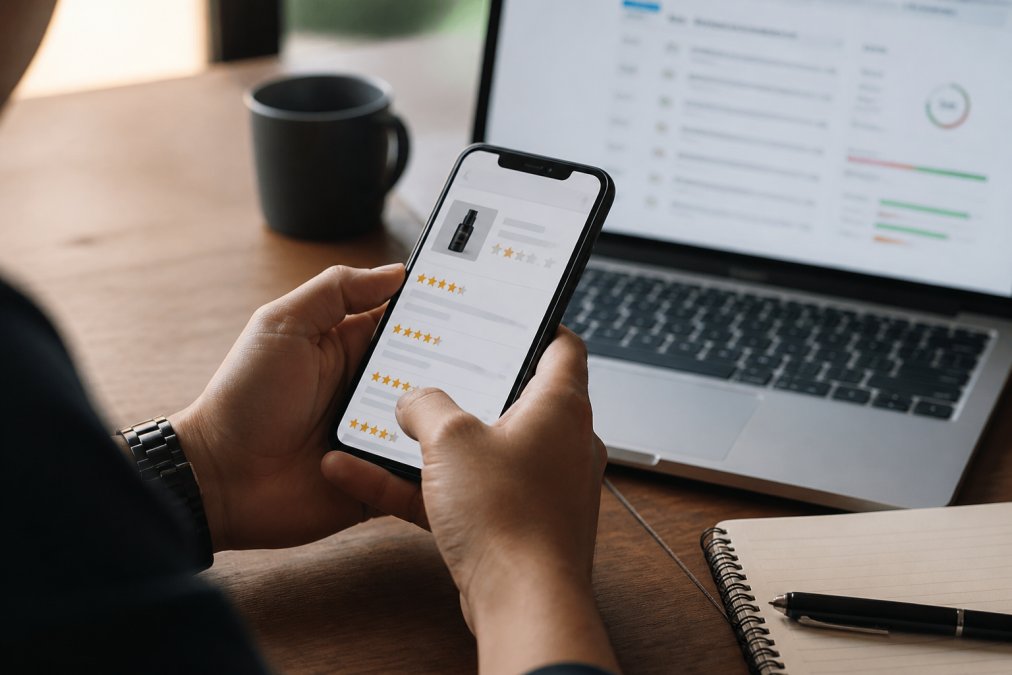
Review frequency matters too: a steady trickle over months reads differently than a burst of identical praise in one week. Check whether reviewers have other platform activity, single-review accounts are common among bot-generated content.
Using Third-Party Analysis Tools
Several review platforms offer sentiment and authenticity scoring that flags suspicious patterns automatically. Sort by "most recent" and "lowest rated" first, fake campaigns rarely bother with critical feedback, and one- and two-star reviews reveal real weaknesses better than a wall of perfect scores.
Identifying Legitimate Online Stores and Trust Signals
Legitimate stores share predictable trust signals: a physical address, a working customer service contact, clear return terms, and recognizable payment processors at checkout.
E-commerce Security Checks: Payment Gateways and Data Privacy
Check the URL before entering payment details. A secure checkout uses HTTPS, shown by the padlock icon in your browser. Be wary of sites that redirect you to an unfamiliar payment page or that only accept wire transfers or gift cards, since those methods offer no buyer protection. The Federal Trade Commission's guidance on online shopping scams outlines common payment red flags and how to report them.
Also look for a privacy policy and terms of service. Legitimate retailers publish both; their absence isn't automatically fraud, but combined with other warning signs, it's a strong signal to walk away.
How to Check Brand Authenticity and Seller Credibility
Brand authenticity checks start with the manufacturer, not the seller. Visit the brand's official site and confirm the product model exists in their catalog. Counterfeit listings often use real brand names on products the brand never made, a practice the U.S. Patent and Trademark Office's counterfeit awareness resources and U.S. Customs and Border Protection's guidance on counterfeit goods both document as a growing problem in e-commerce.
Verify the Model Number, Not Just the Brand
A real brand name proves nothing. You want a model number or SKU that appears in the manufacturer's own catalog. Search the brand's site for the exact model string, a SKU like "DCD771C2" rather than "DeWalt drill." No match means the listing is discontinued, a regional variant, or a counterfeit, all three deserve extra scrutiny.
Also check the manufacturer's "Where to Buy" or "Authorized Retailers" page. If the seller isn't listed, the product may still be genuine, but you often lose the manufacturer's warranty, a trade-off worth knowing before you pay.
Trace the Supply Chain When It Matters
Supply chain transparency is the fastest way to separate a real brand from a convincing fake. Look for these signals on the listing or the brand's site:
- Country of origin and manufacturing address. A "Made in" line that contradicts the brand's known production footprint is a red flag.
- Third-party certifications. ISO 9001 (quality management), UL or ETL marks (electrical safety), NSF (food and water contact), and Fair Trade Certified (agricultural and textile goods) are verifiable. Each issuing body publishes a searchable database, so you can confirm the certificate number rather than trusting a logo image.
- Lot or batch codes. Legitimate manufacturers print these on the product or packaging. Counterfeits often skip them because they can't be traced.
- GS1 barcodes. A UPC or EAN that resolves to the correct company in a public barcode lookup is a stronger signal than a printed logo.
A certification badge with no certificate number is decoration, not evidence.
Score the Seller on Four Axes
Score the seller on four axes before you buy:
- Identity. A registered business name, a physical address, and a working phone number beat a random username every time. You can cross-check a business name against your state's Secretary of State business registry.
- History. How long has the account been active? A seller with years of listings and a stable feedback trend is lower risk than one created last month.
- Responsiveness. Read how the seller replies to critical reviews. A professional, specific response ("We replaced the unit under warranty on [date]") signals a real operation. Copy-pasted apologies or silence signal the opposite.
- Policy clarity. Return window, restocking fees, and warranty terms should be stated in plain language on the listing, not buried in a linked PDF.
When to Walk Away
Stack the signals. One weak axis is a caution; two or three together is a walk-away. A new seller account, a model number that doesn't exist on the brand's site, and a certification badge with no verifiable number is not a listing worth your money, no matter how good the price looks.
Reading Product Specifications and Material Quality
Specifications tell you what a product actually is, and vague specs tell you the seller doesn't want you to know. "Premium material" without a name is hiding something.
Look for specifics: fabric composition, dimensions, weight, power ratings, and compatibility details. Compare them against the manufacturer's official specs. Mismatches, like a claimed capacity that doesn't match published figures, point to a counterfeit or misrepresented item.
Verifying Product Quality with Visual Techniques and Post-Purchase Testing
Visual verification is one of the most underused checks. Listing photos carry as much signal as reviews, and the first ten minutes after a package arrives can tell you more than a week of pre-purchase research.
Reading Listing Photos Like Evidence
Zoom into every listing photo and look for inconsistencies that a legitimate seller wouldn't ship:
- Mismatched logos or fonts. A brand's wordmark is consistent across every product it makes. Slight variations in letter spacing, weight, or color are common in counterfeits.
- Blurry or pixelated label text. Genuine product photography is shot at high resolution. If the label text is soft while the rest of the image is sharp, the label may have been swapped in.
- Reused stock images. Run a reverse image search (Google Images, Bing Visual Search, or TinEye) on the main product photo. If the same image appears on unrelated listings under different brand names, the seller didn't shoot it, and may not have the product at all.
- Inconsistent lighting or shadows. A product composited onto a new background often has shadows that don't match the scene. Look at where the light falls and whether the shadow direction is consistent.
- Missing detail shots. Legitimate listings usually show the product from multiple angles, including close-ups of stitching, ports, or seams. A single glossy hero image with no detail shots is a warning sign.
Spotting AI-Generated Product Imagery
AI-generated product photos are common enough that shoppers need a basic detection routine. Look for:
- Nonsense text. AI image models frequently produce garbled letters on labels, packaging, or screens. Zoom in, if the text on a "brand" label doesn't spell a real word, the image is likely synthetic.
- Impossible geometry. Buttons that merge into fabric, zippers that don't line up, or straps that disappear behind a surface are telltale artifacts.
- Too-perfect surfaces. Skin, fabric, and metal in AI images often look slightly plastic or over-smoothed, with no grain or wear.
- Hands and reflections. Fingers, jewelry, and mirror reflections are still weak points for image models. Count the fingers. Check whether the reflection matches the product.
If a listing's photos look synthetic, ask the seller for a real photo of the actual unit, ideally with a handwritten note or specific object in frame. A legitimate seller will comply; a drop-shipper or counterfeiter usually won't.
The Unboxing Inspection: Your First Ten Minutes
Post-purchase testing pays off only inside the return window, not weeks later. Set aside ten minutes when the package arrives and run this routine:
- Photograph the package before opening. Note any damage, and keep the photos. Some carriers and sellers require them for claims.
- Match the model and serial number. Compare the number on the product and the box against the listing and the manufacturer's site. A mismatch is an immediate return.
- Check the packaging quality. Genuine brands use consistent print quality, correct trademark symbols, and sealed or tamper-evident packaging. Misspellings, off-color logos, or flimsy boxes are common counterfeit tells.
- Inspect the product itself. Look for uneven seams, misaligned buttons, rough edges, chemical odors, or paint that wipes off. These are finish-quality failures that reviews rarely mention.
- Test the function against the listing's claims. If the listing says 20,000 mAh, charge a known device and see whether the math holds. If it says waterproof, check the rating (IPX4 vs. IPX7 matters). If it says a specific fabric blend, check the tag.
- Register the warranty if the manufacturer offers it. Registration often requires a valid serial number, so it doubles as a counterfeit check. If registration fails, the product may not be genuine.
Mobile-Specific Verification
If you're buying through an app or social commerce link, the same checks apply, but the interface hides some signals. Tap the seller's name to open their full profile rather than trusting the storefront preview. Long-press the product image to see whether it's hosted or links externally. Before you tap "Buy," copy the product URL into a browser and check the domain, social commerce links often redirect to unfamiliar checkout pages without the platform's buyer protection.
Comparing Products Across Multiple Platforms
Cross-platform comparison exposes pricing and quality outliers fast. A product listed far below the typical range usually signals a counterfeit, a used item sold as new, or a listing that won't ship what's pictured.
Build a simple comparison before you commit:
| Check | What to Compare | Red Flag |
|---|---|---|
| Price | Against 2-3 other listings | Far below the typical range |
| Reviews | Volume and recency | Burst of identical praise |
| Seller | History and responsiveness | New account, no feedback replies |
| Specs | Against manufacturer's site | Vague or mismatched details |
| Returns | Policy length and terms | No returns or unclear terms |
This table doubles as a quick pre-purchase checklist. Run each row before you check out.
Common Mistakes to Avoid When You Verify Online Product Quality
The biggest mistake is trusting a single signal. One good review, one secure-looking page, or one low price confirms nothing alone. Verification works when you stack several checks together.
Other frequent errors:
- Skipping the return policy until after a problem appears
- Assuming a professional-looking site means a legitimate seller
- Ignoring shipping and handling terms, which often hide restocking fees
- Overlooking warranty coverage details, especially for electronics
For shoppers who want a simpler path, buying from a store that stands behind its return process removes most of this legwork. That's the approach we take at Nehemiah Country Store: many household, electronics, and personal care items, fast shipping, and trending deals, so you spend less time verifying and more time enjoying what you bought.
Frequently Asked Questions
How do I check if a product is legit online before buying?
Start by checking whether the product has a verifiable brand website, look for a star rating distribution that follows a natural curve rather than all five-star reviews, and confirm the listing includes specific product specifications and material details. A legitimate listing will also state a clear return policy and warranty coverage. If the price seems far below market rate or the seller has no verifiable history, treat it as a warning sign.
How can I spot fake online reviews quickly?
Look for clusters of reviews posted on the same day, generic praise that could apply to any product, and reviewers who have only one or two total reviews. Check whether the language patterns feel repetitive or overly promotional. A natural star rating distribution typically shows a mix of ratings, while a wall of perfect scores with no criticism is a common sign of bot-generated content or paid reviews.
What are the signs of a fake online store?
Fake stores often lack a physical address and use a generic contact email. Check for a secure payment gateway (look for HTTPS and recognized payment processors), read the return policy carefully, and search the store name alongside words like 'scam' or 'complaint.' If the site pressures you with countdown timers or limited stock claims on every item, that is a trust signal pointing the wrong way. Legitimate stores provide clear shipping and handling timelines and responsive customer support.
Are there tools to detect fake product reviews?
Yes. There are tools that analyze review patterns. These tools examine review frequency, language patterns, and reviewer history to estimate how many reviews are likely genuine. They are not perfect, but they give you a useful starting point. Combine their output with your own check of product imagery, verified purchase badges, and whether the seller responds to negative feedback.
Verifying every listing yourself takes time most busy shoppers don't have. Nehemiah Country Store simplifies the process with vetted product categories, fast shipping, and trending deals across household essentials, electronics, and personal care. Shop Now and get quality items delivered quickly, without the guesswork.


